

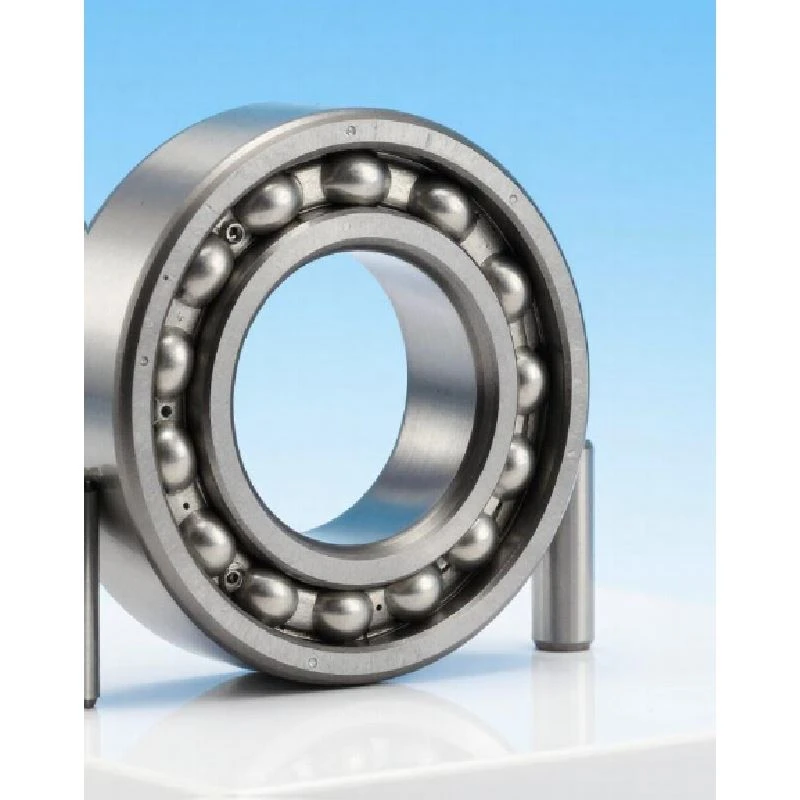
Technical Guide: Metric Thrust Ball Bearing Selection & OEM Sourcing
Metric thrust ball bearings are engineered to accommodate pure axial loads in rotating machinery using metric shaft and housing boundaries in full compliance with ISO 104 and DIN 711 international dimensional standards.
Selecting the correct bearing requires evaluating boundary dimensions, load vectors, dynamic (C) and static (C0) load ratings, rotational speed limits, lubrication regimes, temperature ranges, and tolerance classes.
Metric Thrust Ball Bearing Configuration Types
The primary selection criterion is load directionality: Does the machine apply axial force in a single direction or bi-directionally?
Single-Direction Metric Thrust Ball Bearings
Designed to sustain pure axial loads in one direction. They consist of a shaft washer with a precision raceway, a housing washer, and a ball and cage assembly.
- Compliant Standards: ISO 104 / DIN 711
- Typical Applications: Machine tool spindles, centrifugal pumps, industrial gearboxes, screw jack mechanisms, vertical shaft supports, and linear positioning devices.
Double-Direction Metric Thrust Ball Bearings
Utilized when axial forces reverse direction during operation. These units consist of one central shaft washer, two housing washers, and two ball and cage assemblies.
- Compliant Standards: ISO 104 / DIN 711
- Typical Applications: Reversing industrial gear drives, double-acting positioning systems, multi-stage pumps, and machinery with alternating thrust vectors.
Critical Boundary Dimensions & Tolerances
Identify metric thrust ball bearings using three fundamental dimensions: d x D x H
d: Bore diameter (Shaft washer inner diameter)
D: Outside diameter (Housing washer outer diameter)
H: Overall boundary height (Total assembly thickness)
Engineering Caution: Never select a replacement bearing based on bore diameter (d) alone. Bearings sharing an identical bore size often differ in outside diameter, total height, raceway curvature, load capacities, and limiting speeds.
|
Precision Class |
Applicable Standard |
Bore Variance (d) |
OD Variance (D) |
Key Application |
|
Class Normal (P0) |
ISO 199 / DIN 620 |
Standard ISO tolerance |
Standard ISO tolerance |
General industrial machinery |
|
Class P6 |
ISO 199 / DIN 620 |
Reduced tolerance |
Reduced tolerance |
Gearboxes & standard pumps |
|
Class P5 / P4 |
ISO 199 / DIN 620 |
Precision ground |
Precision ground |
High-precision machine tool spindles |
Axial Load Capacity & Operating Parameters
Thrust ball bearings must be evaluated against continuous operating loads, peak forces, and thermal conditions:
Dynamic Load Rating (C): Dictates bearing Fatigue Life (L10) calculations under operational rotation.
Static Load Rating (C0): Evaluates maximum permissible loads on stationary or slow-oscillating bearings to prevent permanent raceway deformation.
Speed Limits & Thermal Behavior: Catalog speed ratings serve as baseline guidelines. Operational speeds depend directly on applied load, oil vs. grease viscosity, heat dissipation, and mounting fits.
Application Exclusions
Thrust ball bearings are not suitable for:
Significant radial load components (Fr)
Severe angular misalignment between shaft and housing
Heavy impact or high shock loads
Ultra-high-speed applications exceeding thrust limit factors
Material Specifications & Standards
|
Component |
Material Options |
Standard / Grade |
Key Mechanical Properties |
|
Shaft & Housing Washers |
High-Carbon Chrome Steel / Stainless Steel |
100Cr6 / SAE 52100 / AISI 440C |
Hardness: 58-64 HRC, high fatigue resistance |
|
Rolling Elements (Balls) |
Bearing Steel / Silicon Nitride Ceramic |
GCr15 / Si3N4 |
Grade 10 or 16 high sphericity |
|
Cage Assemblies |
Pressed Steel / Machined Brass / Polyamide |
Steel (Standard), Brass (M), Nylon (TN9) |
Low friction coefficient, temperature stable |
Quality Assurance & Manufacturing Verification
|
Production Step |
Quality Control Parameter |
Inspection Tool / Instrument |
|
Raw Material Inspection |
Chemical composition & internal purity |
Spectrometer & Ultrasonic flaw detector |
|
Turning & Machining |
Inner/Outer boundary dimensions |
Digital micrometers & Vernier calipers |
|
Heat Treatment |
Hardness depth & microstructure |
Rockwell hardness tester (HRC) |
|
Raceway Grinding |
Profile geometry & surface finish |
Optical profilometer (Target: Ra <= 0.2 um) |
|
Assembly & Final QC |
Dimensional runout, noise & vibration |
Formtester & Vibration meter (Z1/V1 to Z3/V3) |
FAQ
Q: Can metric thrust ball bearings accommodate radial loads?
A: No. Metric thrust ball bearings are designed exclusively for pure axial (thrust) loads. Applying radial loads causes non-uniform stress distribution on the raceways and premature bearing failure. If your application involves combined radial and axial loads, consider tapered roller bearings or angular contact ball bearings.
Q: What is the main structural difference between single-direction and double-direction thrust bearings?
A: Single-direction thrust bearings consist of two washers (shaft and housing) and one ball-and-cage assembly, supporting axial load in one direction. Double-direction thrust bearings feature three washers (one central shaft washer and two housing washers) and two ball-and-cage assemblies, allowing them to support axial loads acting in both directions.
Q: How do I select between grease and oil lubrication for thrust ball bearings?
A: Grease is suitable for low-to-moderate speeds and operating temperatures below 120 deg C, providing simple sealing and lower maintenance. Oil lubrication (such as oil bath or circulating oil) is recommended for high-speed applications, heavy continuous loads, or high operating temperatures where heat dissipation is required.
Q: Why can't I identify a replacement thrust bearing using only the bore size (d)?
A: Multiple bearing series share the same bore size (d) but feature significantly different outer diameters (D), overall heights (H), load capacities, and limiting speeds (e.g., 511 Series vs. 512 Series). Matching all three dimensions (d x D x H) is required to guarantee mechanical fit and operational compatibility.
Q: What documentation is provided for OEM and bulk quality compliance?
A: Standard OEM supply documentation includes Material Test Certificates (EN 10204 3.1), Dimensional Inspection Reports, Heat Treatment Records, and Certificate of Analysis (CoA) for surface roughness and hardness testing upon request.
Hot Tags: metric thrust ball bearings, China metric thrust ball bearings manufacturers, suppliers, factory, Thin Section Deep Groove Ball Bearings


