

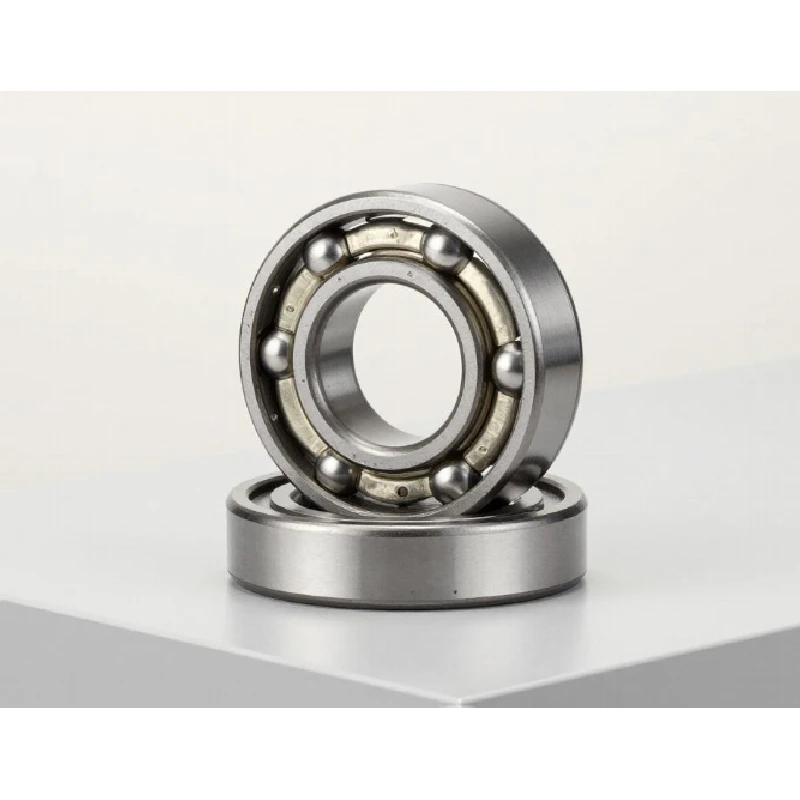
Double Direction Thrust Ball Bearings are engineered to support axial loads acting in both directions and provide rigid axial positioning for rotating shafts. They are ideal for machinery where axial loading reverses during operation or where shafts require controlled location from both sides.
Quick Selection Guide
|
Application Requirement |
Recommended Bearing Selection |
|
Axial load acts mainly in one direction |
Single Direction Thrust Ball Bearing |
|
Axial load acts in both directions |
Double Direction Thrust Ball Bearing |
|
Significant radial and axial combined loads |
Angular Contact Ball / Tapered Roller Bearing |
|
Heavy axial load at low to moderate speeds |
Thrust Roller Bearing (Cylindrical / Spherical) |
|
High precision and high speed screw drives |
Angular Contact Thrust Ball Bearing (e.g., ZKLN series) |
Technical Specifications
|
Parameter |
Selection Requirement |
Industry Standards / Options |
|
Bearing Type |
Double Direction Thrust Ball Bearing |
ISO 104 / DIN 711 series |
|
Load Direction |
Bidirectional axial load |
2 separate load paths |
|
Bore Diameter (d) |
According to shaft diameter |
Metric or Inch series |
|
Outside Diameter (D) |
According to housing space |
Standard or compact series |
|
Overall Height (T) |
According to available axial space |
Standard height profile |
|
Dynamic Load Rating (Ca) |
Based on required L10 service life |
Calculated per ISO 281 |
|
Static Load Rating (C0a) |
Checked against peak and static loads |
Calculated per ISO 76 |
|
Precision Class |
Matched to application requirements |
ISO Normal (P0), P6, P5 / ABEC 1, 3, 5 |
|
Bearing Material |
Through-hardened bearing steel |
100Cr6 / AISI 52100 / SUJ2 |
|
Cage Material |
Matched to speed and temperature |
Pressed steel, machined brass, or PA66 |
|
Lubrication |
Selected by speed, load, and environment |
Mineral/synthetic grease or circulating oil |
|
Operating Temperature |
Determined by material and lubricant |
Standard -30°C to +120°C |
How to Select the Correct Bearing
Confirm Load Direction & Magnitude: Verify that axial forces act in both directions. Calculate continuous axial load (Fa), peak impact loads, and static conditions.
Verify Operating Speed: Check the allowable speed against actual operating conditions. High-speed continuous operation requires evaluating the lubrication method and thermal dissipation together.
Evaluate Radial Forces: Standard thrust ball bearings cannot support radial loads. If radial forces exist, specify them separately so an additional radial bearing can be integrated into the system.
Confirm Installation Dimensions & Tolerances: Verify shaft diameter (d), housing outer diameter (D), and bearing height (T). Specify precision limits (ISO P6 or P5) where tight axial runout control is required.
Select Lubricant & Temperature Limits: Choose grease or oil based on speed limits, temperature ranges, maintenance intervals, and environmental conditions.
Structure & Working Principle
A double direction thrust ball bearing contains five main components that direct forces along two distinct pathways:
Shaft Washer: Fits the rotating shaft and acts as the inner raceway.
Central Washer: Located between the two ball sets, forming part of the reversing load path.
Housing Washers: Positioned inside the stationary housing bore to receive axial force.
Ball & Cage Assemblies: Retain precision rolling elements that transfer loads through raceways.
Load Path Direction A: Shaft -> Shaft Washer -> Ball Assembly 1 -> Central Washer
Load Path Direction B: Shaft -> Central Washer -> Ball Assembly 2 -> Housing Washer
Manufacturing Specifications & Quality Control
|
Process Step |
Engineering Specification |
QC Inspection Protocol |
|
Raw Material |
Through-hardened 100Cr6 / AISI 52100 steel |
Chemical composition & ultrasonic flaw testing |
|
Heat Treatment |
Controlled quenching and tempering |
Hardness testing (58 - 64 HRC) & microstructure check |
|
Raceway Grinding |
CNC precision raceway profiling |
Surface roughness (Ra) & geometry verification |
|
Ball Selection |
ISO 3290 high-precision grade steel balls |
Diameter sorting, roundness, & surface inspection |
|
Final Quality Assurance |
ISO / DIN standard compliance |
Dimensional check (d, D, T), noise/vibration testing, and batch traceability |
Bearing Type Comparison
|
Bearing Type |
Load Capability |
Direction |
Key Application |
|
Single Direction Thrust Ball |
Pure Axial |
One direction |
Simple unidirectional thrust loads |
|
Double Direction Thrust Ball |
Pure Axial |
Both directions |
Reversing axial loads, moderate speeds |
|
Cylindrical Thrust Roller |
Heavy Axial |
One or both directions |
Heavy duty industrial thrust mechanisms |
|
Tapered Roller Bearing |
Combined (Axial + Radial) |
One direction (per bearing) |
Gearboxes, automotive wheel hubs |
|
Angular Contact Thrust Ball |
High Axial + Limited Radial |
Both directions |
High-speed, high-precision ball screw drives |
Typical Applications
Rotary tables and indexing units requiring bidirectional axial location.
Helical or bevel gear drives generating reversing axial thrust.
Vertical pumps, mixers, and agitators subjected to alternating axial forces.
Linear drives operating at moderate speeds requiring axial positioning.
OEM Procurement Checklist
- Reversing axial load profile confirmed
- Shaft bore diameter (d), housing diameter (D), and total height (T) verified
- Operating speed vs. lubricant speed rating checked
- Precision class defined (ISO Normal, P6, or P5)
- Required documentation confirmed (Material Certificates, Dimensional Reports, Certificate of Conformity)
- Packaging specifications defined (VCI anti-rust paper, individual box, export pallet)
FAQ
Q: Can double direction thrust ball bearings accommodate radial loads?
A: No. Standard double direction thrust ball bearings are designed strictly for axial loading. If your application involves combined radial and axial loads, you should use tapered roller bearings or angular contact ball bearings, or add a separate radial bearing to the shaft assembly.
Q: What is the main structural difference between single and double direction thrust ball bearings?
A: A single direction thrust bearing has one ball and cage assembly and supports axial load in only one direction. A double direction thrust bearing features two ball and cage assemblies, two housing washers, and a central washer, allowing it to support axial loads in both opposite directions.
Q: How do I select the proper cage material for high-temperature applications?
A: Standard pressed steel cages work well for most general applications. However, for elevated temperatures or higher operating speeds, machined brass cages or heat-stabilized synthetic cages (such as PA66) are recommended to ensure dimensional stability and low friction.
Q: Are thrust ball bearings suitable for high-speed ball screw drives?
A: Standard thrust ball bearings are best suited for low to moderate speed applications. For high-speed, high-precision screw drives or machine tool spindles, specialized angular contact thrust ball bearings are recommended because of their higher stiffness and speed capability.
Q: What technical details should be provided when requesting an OEM quotation?
A: To get an accurate quote, provide the bearing designation or technical drawing. If the designation is unknown, specify the boundary dimensions (Bore d x Outer Diameter D x Height T), operating loads (Fa), operating speed (RPM), required precision class (ISO P0/P6/P5), and annual order volume.
Hot Tags: double direction thrust ball bearings, China double direction thrust ball bearings manufacturers, suppliers, factory, Thin Section Deep Groove Ball Bearings


