

As a core component of modern machinery, roller bearings consist of an outer ring, rolling elements (cylindrical/spherical), a cage, and an inner ring. Efficient force transmission is achieved through the rolling elements. Key advantages include: low starting torque (reduced energy consumption), high rotational accuracy (±0.001mm), adaptability to various scenarios (radial load capacity up to 50kN, tapered rollers can also handle axial loads), and convenient maintenance. They also have a low coefficient of friction (0.001-0.005), making them widely used in high-precision machine tool spindles (runout ≤0.005mm) or heavy-duty rolling mills. However, limitations such as high noise levels (70-85dB) and relatively high manufacturing costs should be noted. Among the sub-types, self-aligning roller bearings (double-row design) are particularly suitable for vibration environments such as papermaking machinery, while tapered roller bearings are suitable for complex load conditions such as gearboxes.
Popular Products

Rod End Bearing M8
This series is classed as rod end bearings requiring maintenance. Comprising of sliding contact surfaces of steel
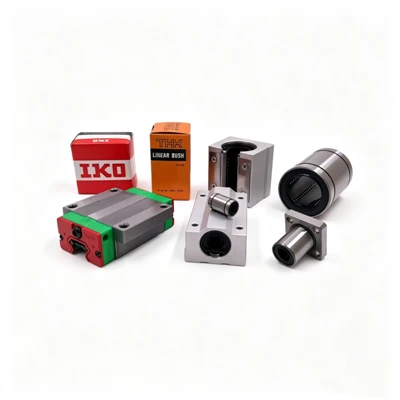
Linear Guide Rail
A linear guide is a machine element that utilizes bearings, which were developed for rotary motion, in order to move

Pillow Block Bearing P209
Pillow (plummer) block ball bearing units consist of an insert bearing mounted in a cast iron housing that can be

30208 Taper Roller Bearings
Tapered roller bearings are designed so that the imagined conical apices formed by the raceways of the inner and outer

Single Row Cylindrical Roller Bearings For VEK
Cylindrical Roller Bearing manufactured with two integral flanges, a machined brass cage and a removable inner ring.

22324 Spherical Roller Bearings
A spherical roller bearing is a robust, self-aligning rolling-element bearing designed to handle heavy radial and axial

7205 Angular Contact Ball Bearing
Angular contact ball bearings feature a contact angle that sustains significant axial loads in one direction at the

All Kinds Of Deep Groove Ball Bearings
Products Description All Kinds Of Deep Groove Ball Bearings are a type of rolling element bearing characterized by

Open Miniature Ball Bearings
Open miniature ball bearings are unshielded deep groove ball bearings engineered to support rotating shafts in compact,